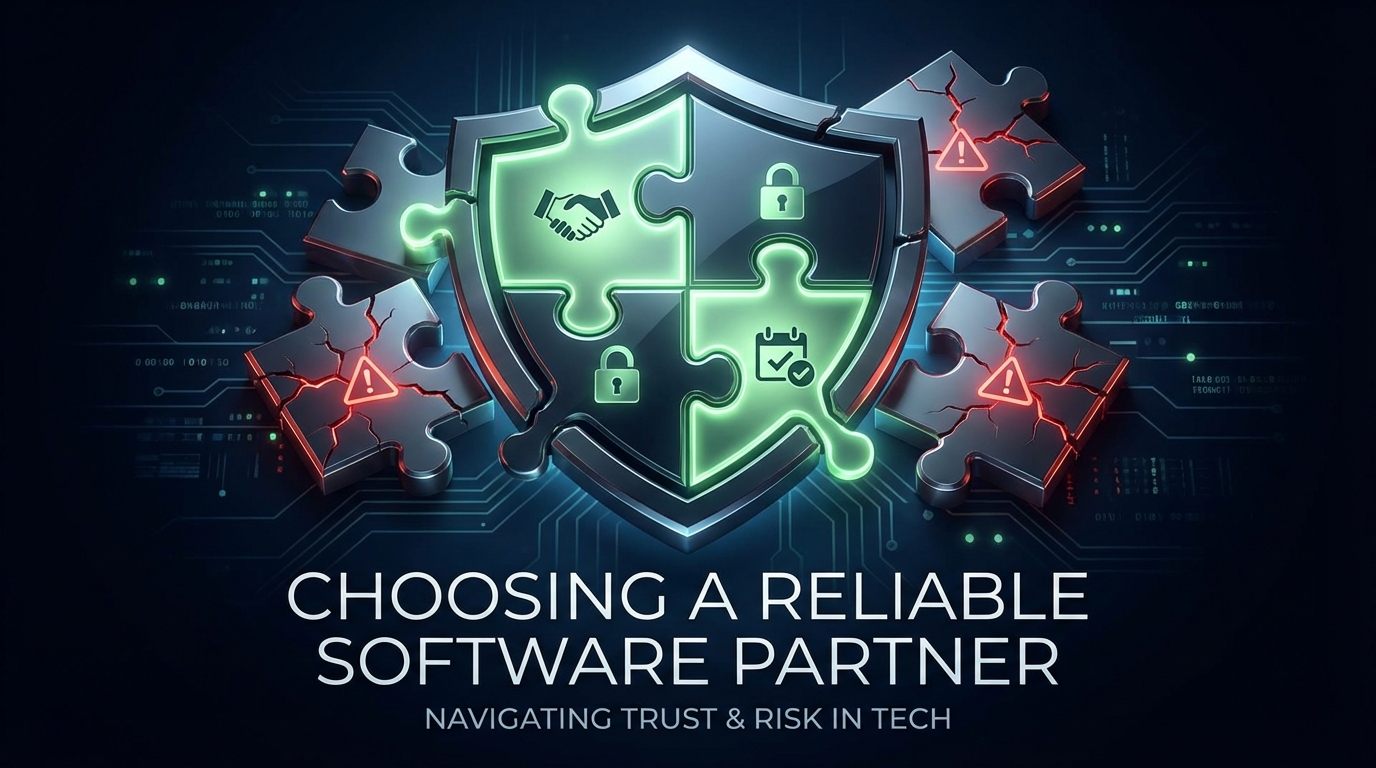
How to Evaluate a Software Development Partner
Red flags, green flags, and the questions that actually matter when choosing who builds your software.
The code can be fixed. A bad partner relationship rarely can.
Choosing the wrong development partner is one of the most expensive mistakes a business can make — and it's rarely about technical skill. The best code in the world doesn't matter if the team can't communicate, can't manage scope, or disappears after launch.
After a decade of building software (and occasionally cleaning up after others), here are the patterns I've seen separate great partners from problematic ones.
The 7 Red Flags and 7 Green Flags

Vetting Development Partners
Signs of a trustworthy partner vs. potential problems
Red Flags
Green Flags
Bottom line: The cheapest quote rarely delivers the best value. Look for partners who invest time understanding your needs before pricing.
Questions to Ask Potential Partners
These five questions reveal more than any sales pitch:
1. "Walk me through a similar project you've completed."
Look for relevant experience and their ability to explain technical decisions clearly. A good partner won't just show you the finished product — they'll walk you through the problems they solved and the trade-offs they made.
2. "What happens after launch?"
Good partners think beyond deployment. They should have clear answers about maintenance, support, and knowledge transfer. If a firm's plan ends at "we deploy it," that's a problem. Software needs ongoing care — security patches, bug fixes, feature updates, infrastructure monitoring.
3. "How do you handle scope changes?"
Because scope will change. Look for processes that acknowledge this reality without punishing you for it. The best partners have a clear change request process: document the change, estimate the impact, get approval, then build.
4. "Can I talk to a recent client?"
References matter. Someone who's worked with them in the last 6 months can tell you more than a polished case study. Ask that reference: "Would you hire them again? What surprised you? What would you do differently?"
5. "What could go wrong with this project?"
Partners who can articulate risks are partners who've thought about them. Run from anyone who says "nothing." Every project has risks — timeline, scope, technical complexity, integration challenges. A good partner identifies them upfront and has mitigation strategies.
What to Look for in the Proposal
Beyond the red and green flags, pay attention to how a partner structures their proposal:
- Assumptions are listed explicitly. Every estimate is built on assumptions. Good partners name them so you can validate (or correct) before work begins.
- Phases are defined. "We'll build the whole thing in 6 months" is less trustworthy than "Phase 1 delivers X in 8 weeks, then we reassess."
- Ongoing costs are mentioned. If a proposal only covers development and ignores hosting, maintenance, and third-party services, the total cost picture is incomplete.
- Technology choices are justified. Not "we use React because it's popular" but "we recommend React because your team can hire React developers easily, and it's well-suited to your interactive dashboard requirements."
The Trust Test
At the end of the evaluation, ask yourself one question: "Did this team try to understand my business, or just my feature list?"
Partners who ask "why" before "what" are partners who'll build the right thing, not just the thing you described. That distinction is worth more than any discount.
This post is part of our custom software pricing guide. For pricing ranges and budget planning, start there.
Looking for a Development Partner?
We'll ask about your business problem first, not your feature list. If we're not the right fit, we'll tell you.
Schedule a Discovery CallEnjoyed this post?
I write about AWS, React, AI, and building products. Have a project in mind? Let's chat.